|
Essays About Hannah Wilke
|
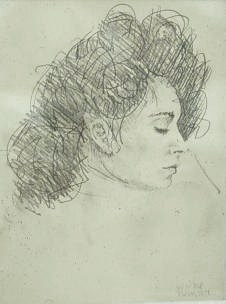
| Hannah Wilke: Self Portrait, 1978 |
Hannah Wilke
by Nancy Princenthal
Perhaps more than her sexual candor, the quality that distinguished
Wilke among her peers--and that forms the most illuminating comparison with artists of succeeding generations-- is her spirit
of affirmation.... Wilke invited us to enter her life in it's every particular--and, equally, to find our own lives reflected
there.... Wilke insisted on exploring and expressing the body's most insistent and powerful conditions....The formal
intelligence of her sculpture and, later, the theoretical reach of her photography were what she most wanted acknowledged.
Carrying on her legacy are, really, any artists who flaunt their gifts and present irresolvably perplexing challenges to critical
protocol...
Excerpts from Hannah Wilke by Nancy Princenthal
Copyright Nancy Princenthal
Prestel Publishing, New York, 2010
Hannah Wilke: Making Myself Into a Monument
by Tracy Fitzpatrick
Wilke's practise is rooted in her devotion to malleability
and her interest in vulnerability....For Wilke these forms were a language reflecting the pleasures and pains of the female
experience, both universal and specific.... Wilke first adopted vaginal imagery in the late 1950's, before most other artists
who also produced what later came to be termed feminist "essentialist" art, or art that stemmed from imagery of the female
body.... The ultimate expression of Wilke's sculptural priorities ... is Wilke's adaptation of her own body as sculptural
material --as what she called "living sculpture." ... Considering these works as rooted in a sculptural practise raises a
range of new insights and ... demonstrate the line Wilke walked between her desire to investigate the transitory nature of
art and life and her desire to create a lasting record of her own art and life....
Excerpts from "Hannah Wilke: Making Myself Into A Monument," by Tracy
Fitzpatrick.
Copyright Tracy Fitzpatrick, Neuberger Museum of Art.
Published in exhibition catalog Hannah Wilke: Gestures, Neuberger
Museum of Art, 2009.
|
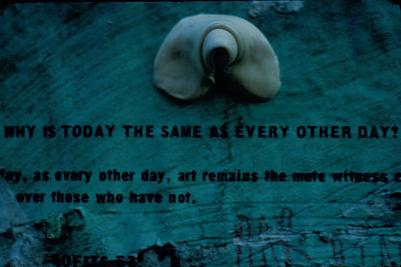
| Hannah Wilke: Gum on postcard |
The Eternal Hannah Wilke: Philosophy in
Form
by Arlene Raven
Like Eve, the first woman, Wilke is self-originating with a vengeance.
And she has often been first. She was the first, for instance, to make
vaginal art. Her terra cotta labia of the 1960's, invented and self-appropriated to be fashioned in every medium she ever
used, are a fertile source for the female imagery of the feminist artists of the next decade....The
artist bares herself in sensual drawings, photographs, sculptures, performances and film. Hers is a self-documentation and
a feminist art form; starkly personal, culturally historical, and symbolically transcendent. Wilke was passionate in this
portrayal all of her life. She has driven deep into her corporeal self to produce a legacy for the sacred collective
that is so seminal and fundamental that she has been and remains a lodestar.... Wilke
eschews euphemism often used to cover abuses of power. Underlieing the inextricable connection between language and
truth, this artist's lexacon becomes a blunt badge of moral courage that melds personal, cultural, and artistic
truths....
Excerpts from "The Eternal Hannah Wilke" by Arlene
Raven.
Copyright the Estate of Arlene Raven.
Published in Hannah Wilke: Selected Work,
1960-1992,
Hannah Wilke Collection & Archive, Los Angeles,
and SolwayJones, 2004.
Hannah Wilke
by Joanna Frueh
Throughout her career Wilke has engaged, confronted, and led significant developments in contemporary and
twentieth century art.... Wilke is one of the few artists creating female erotic discourse, and she is the only one to consistently
use both herself and sculptural forms.... It was Wilke ... who originated vaginal imagery, as signature, as feminist
statement, as universal symbol....a signature is the manifestation of intimate poetics, the presence of a self that can project
vision and belief.... Wilke creates a multiplicity ... beautiful objects that speak not of Otherness, the position into which
a male-dominant society has cast women ... The sensuously folded shells are exist-ential, treating the importance of
eroticism as an energy that must permeate an individual's life if it is to be vital....They deal with women's reproduction
of life, but not, however, as purely anatomical glorification....Wilke recognizes that women are life-givers, people who not
only give birth literally but who also bring forth ideas and art, who create culture and society....Her intention is to make
a female form universal, to have it seen as symbolic of both women's and humanity's concern.
Excerpts from "Hannah Wilke" by Joanna Frueh. Copyright Joanna Frueh.
Published in Hannah Wilke:A Retrospective, University of Missouri Press,1989.
|
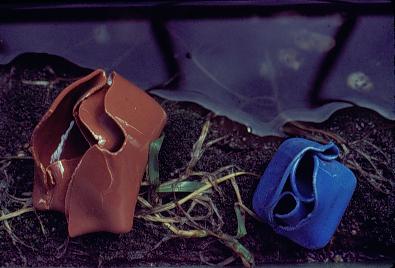
| Hannah Wilke: Ceramic Sculptures |
Intra Venus and Hannah Wilke's Feminine
Narcissism
by Amelia Jones
Wilke's radical narcissism culminated in her acerbic, witty, and tragic Intra Venus, the last project
she completed before she died of lymphoma in1993....Wilke's work ... functions more subtly to interrogate and explore
profound issues of the embodied female subject as both artistic subject and object. Wilke refuses the construction of woman
as the pathetic, obscene, victimized subject of the patriarchal gaze ... offering her body within a fully theorized array
of expressions ... that articulate a pro-active rather than re-active feminist subject. Through her myriad, often contradictory
presentations of her self, Wilke solicits this gaze, grafting it onto and into her body/self, taking hold of it and reflecting
it back to expose and exacerbate its reciprocity.... Wilke's sense of humor and compulsion to perform once again transformed
an objectifying practice into an opportunity for self-expression.
Excerpts from "Intra Venus and Hannah Wilke's Feminine Narcissism"
by Amelia Jones. Copyright Amelia Jones.
Published in Intra Venus, Ronald Feldman Fine Arts, New York, 1995.
'Everybody Dies, Even the Gorgeous:'
Resurrecting the Work of Hannah Wilke
by Amelia Jones
Wilke's self-love, so Intra Venus seems to say, had a depth that is moving in a lacerating kind of
way. Paradoxically, in the reiterative self-display of the Intra-Venus works, Wilke suggested that her self-love
was built of self-knowledge--and thus subversive of the patriarchal construction of the feminine body as only a picture, only
display. This, then, is the other side of the artifice highlighted in her earlier performative self-portraits. ...Wilke's
works have never been about a superficial self isolated as pretty picture, but about a female subject deeply absorbed
in its own embodied self-reflection....
The beauty here is not that of appearance, but of being--a being that persists, struggles, in the face of
death's inexorable and "untimely" approach.
Excerpts from "'Everybody Dies... Even the Gorgeous:' Resurrecting the Work of Hannah Wilke" by Amelia Jones.
Copyright Amelia Jones.
First published in markzine.com, 2003. Reprinted in The Rhetoric of the Pose: Rethinking Hannah Wilke,
University of California, Santa Cruz, 2005.
|
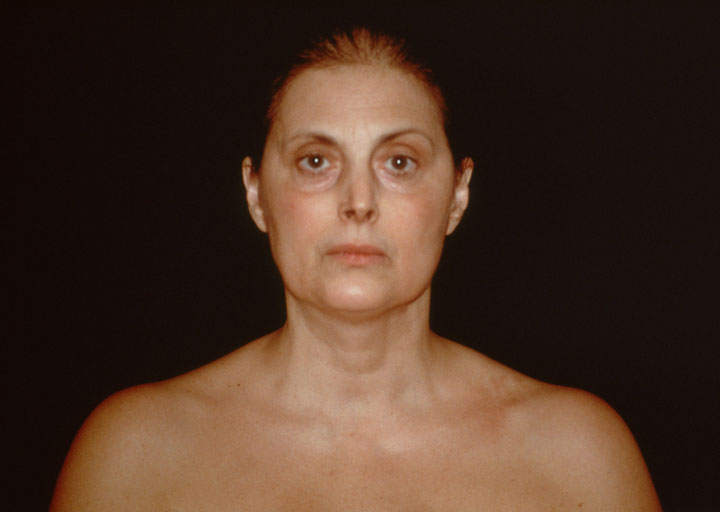
| Hannah Wilke: Intra Venus 7, 1992-3 (left image in diptych) Copyright Donald Goddard. |
|

